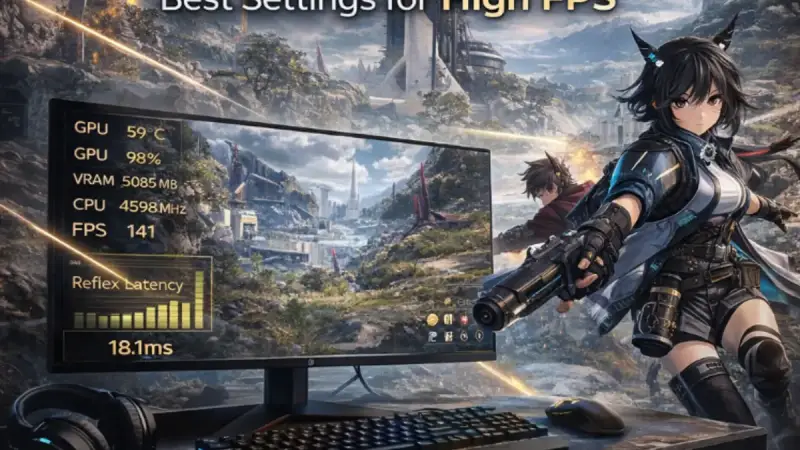
Arknights: Endfield received a 3x performance boost headline when DLSS 4 Multi-Frame Generation launched — and it’s real, but it comes with hard GPU requirements and tradeoffs that most guides skip over. You can’t just flip a switch and triple your FPS on any hardware. This guide explains exactly what DLSS Quality, DLSS Frame Generation, and FSR do inside Endfield, which GPU tiers can actually use them, and when enabling them makes your game look and feel better versus worse. Our full Arknights: Endfield performance guide covers the complete settings picture — this article focuses entirely on upscaling and frame generation so you can make an informed decision for your specific setup.
Quick wins if you are in a hurry
- NVIDIA GPU on RTX 40 or 50 series? Enable DLSS Quality + Frame Generation. This is the single biggest FPS gain available in Endfield with minimal visual cost. Set DLSS to Quality mode first, then turn Frame Generation on.
- RTX 20 or 30 series? Use DLSS Quality only, skip Frame Generation. Frame Generation requires RTX 40/50. DLSS upscaling alone still gives meaningful FPS gains with better image quality than FSR at equivalent settings.
- AMD GPU? Enable FSR Quality mode. FSR is GPU-agnostic and works on any card. Quality mode keeps visual degradation acceptable. Performance mode is only worth it if you’re severely CPU or GPU limited.
- Not hitting your target FPS even with upscaling on? Lower your base render resolution first. Upscaling works better when it has a consistent internal resolution to work from.
Got 10 more minutes? Keep reading for the full breakdown.
Before you go further
This guide assumes your base system is already configured correctly. Upscaling and frame generation are multipliers on top of a working foundation; they won’t fix a poorly optimized system. If you haven’t set your core graphics settings yet, start with the Arknights: Endfield PC performance guide and come back here once that’s done.

Grab Your 6★ Weapon Before It's Gone!
- Free-to-play strategy
- Optimized for Windows PC

Start With 10,000+ Oroberyls , Hit Play!
- Arknights: Endfield — Free on PC. 10,000
- Oroberyls up for grabs.

Your Squad's Waiting. Jump In Free!
- New Homecoming Expansion: 2 Maps, 2 Operators, 1 Free 6★ Weapon: $0.
- Action RPG - Base Building on PC-Play Free, Keep Your Progress on Mobile.
Does Arknights: Endfield support DLSS, Frame Generation, and FSR?
Yes to all three. Endfield ships with support for NVIDIA DLSS 4 (including Multi-Frame Generation), AMD FSR, and Intel XeSS. The implementation is native, not a driver-level hack, which means the upscaling is properly integrated into the render pipeline rather than applied as a post-process afterthought.
Here’s the breakdown of what’s actually available and what hardware each requires:
| Technology | GPU Requirement | What It Does |
|---|---|---|
| DLSS Quality / Balanced / Performance | Any RTX GPU (20 series+) | Renders at lower internal resolution, upscales using AI to near-native quality |
| DLSS Frame Generation | RTX 40 or 50 series only | Generates interpolated frames between rendered frames using Optical Flow Accelerator |
| DLSS Multi-Frame Generation | RTX 50 series only | Generates multiple interpolated frames per rendered frame; source of the “3x boost” headline |
| FSR Quality / Balanced / Performance | Any GPU (AMD, NVIDIA, Intel) | Spatial upscaling, no AI, no hardware lock |
| XeSS | Any GPU (best on Intel Arc) | AI upscaling similar to DLSS; works on non-Intel GPUs at lower quality |
The “3x FPS boost” you may have seen in coverage refers specifically to DLSS Multi-Frame Generation on RTX 50 series. That number is real in ideal conditions but requires an RTX 50 series card and a strong enough base framerate to generate from. On RTX 40 series, Frame Generation typically delivers 1.5x to 1.8x the base framerate, which is still a significant gain.
What settings should I lower first to boost FPS in Arknights: Endfield?
Before touching upscaling, it’s worth understanding that DLSS and FSR are not substitutes for proper settings optimization. They’re a second layer. If your base settings are eating unnecessary GPU resources, upscaling has less to work with.
The settings with the highest FPS impact in Endfield, in rough order:
| Setting | FPS Impact | Notes |
|---|---|---|
| Shadow Quality | Very High | Drop from Ultra to High or Medium first |
| Texture Quality | High | Primarily a VRAM concern, not raw FPS |
| Ambient Occlusion | High | Medium vs Ultra is barely visible, meaningful FPS gap |
| Anti-Aliasing | Medium | Replaced by DLSS/FSR when upscaling is on |
| Post-Processing | Medium | Motion blur and depth of field add cost with little gameplay benefit |
| Particle Quality | Medium-High | Big impact specifically during combat |
| Volumetric Fog | Medium | Expensive relative to visual contribution |
| Reflections | Low-Medium | Drop only if GPU-limited at high resolutions |
Once you’ve dialed those down to a reasonable baseline, then enable upscaling to push FPS further. Enabling DLSS Quality on top of a High preset will look and perform better than enabling it on top of an already-stripped Low preset with nothing left to upscale properly.
What GPU do I need for 1440p high FPS in Arknights: Endfield?
This is where upscaling tech and hardware requirements intersect directly. The answer depends on which upscaling path you’re using.
Without upscaling (native render): You need significant GPU headroom. Based on community testing, hitting stable 60 FPS at native 1440p on High settings requires roughly the performance tier of an RTX 4070 or RX 7800 XT. Ultra settings at 1440p native pushes that requirement higher.
With DLSS Quality (RTX 20/30/40/50 series): DLSS Quality renders at approximately 67% of output resolution internally, then upscales. At 1440p output, you’re rendering closer to 960p internally. This brings the GPU requirement down meaningfully — an RTX 3060 Ti can produce smooth 1440p with DLSS Quality on High settings, based on community benchmark data.
With DLSS Quality + Frame Generation (RTX 40/50 series): Frame Generation needs a stable base framerate to interpolate from. You want at least 60 FPS base before enabling it. If your base is 45 FPS and you turn on Frame Generation, the interpolated frames will feel smooth visually but input latency will increase noticeably because generated frames don’t represent real rendered game state.
| GPU Tier | 1440p Target | Recommended Approach |
|---|---|---|
| RTX 3060 / RX 6700 XT | 60 FPS stable | DLSS Quality or FSR Quality + High preset |
| RTX 3070 / RX 6800 XT | 60-90 FPS | DLSS Quality, no Frame Gen needed |
| RTX 4070 / RX 7800 XT | 100+ FPS | DLSS Quality + optional Frame Gen for 144Hz target |
| RTX 4070 Ti / RX 7900 GRE | 144 FPS | DLSS Quality + Frame Gen hits 144Hz consistently |
| RTX 4080 / 4090 | 144 FPS+ | Native or DLSS Quality; Frame Gen for 240Hz |
If your current GPU isn’t reaching the base framerate you need even with these settings, no amount of upscaling will fully paper over the gap. DLSS Frame Generation in particular requires a solid base to work well. I’ve tested GPUs across the budget-to-high-end range specifically in Endfield — our best GPU guide for Arknights: Endfield breaks down real benchmark numbers at both 1080p and 1440p, including which cards unlock Frame Generation and which deliver the best price-to-performance ratio for this game.
DLSS vs FSR vs XeSS — which should you use?

Short answer: use DLSS if you have an NVIDIA GPU, FSR if you have AMD, XeSS is a decent fallback on Intel Arc hardware.
Longer answer with the actual tradeoffs:
DLSS (NVIDIA): Best image quality at equivalent modes. Uses a trained neural network that’s been specifically optimized over multiple versions. DLSS 4 with the Transformer model produces noticeably sharper results than DLSS 3 in motion-heavy scenes. Endfield benefits from this because combat has a lot of fast particle movement and ability effects that older DLSS versions handled poorly.
FSR (AMD): Fully hardware-agnostic, which is its main advantage. Image quality at FSR Quality mode is acceptable and competitive with older DLSS versions. Fine detail and text can look slightly softer than DLSS 4 at equivalent output resolutions. FSR 4 (where available) closes the gap, but AMD’s AI upscaling still trails NVIDIA’s current implementation on strictly technical grounds.
XeSS: Sits between the two. On Intel Arc hardware it uses the XMX matrix units and produces near-DLSS quality. On AMD or NVIDIA GPUs it falls back to a DP4a path that’s closer to FSR in quality. Unless you’re on an Arc GPU, DLSS or FSR will likely serve you better.
| Technology | Image Quality | Input Latency Impact | Hardware Lock |
|---|---|---|---|
| DLSS 4 Quality | Excellent | Minimal with Reflex | NVIDIA RTX only |
| DLSS Frame Generation | N/A (adds frames) | Increases latency | RTX 40/50 only |
| FSR Quality | Good | Minimal | Any GPU |
| XeSS (Arc) | Excellent | Minimal | Best on Intel Arc |
| XeSS (other GPUs) | Good | Minimal | Any GPU |
One important note on Frame Generation and latency: generated frames improve the fluidity of motion on screen but do not reduce input latency. In fact, they can increase it slightly because the pipeline is now generating frames that sit between your actual rendered frames. NVIDIA Reflex partially compensates for this, which is why the two features are designed to be used together. Always enable Reflex when Frame Generation is on.
Common issues and fixes
Issue: DLSS is enabled but the image looks blurry or smeared in motion. Fix: Check that you’re running DLSS 4 and not an older version. In some cases the game may default to an older DLSS model. Also confirm DLSS Sharpness isn’t set to 0 — a small positive value (around 0.3) helps in Endfield’s visual style.
Issue: Frame Generation is enabled but the game feels less responsive than without it. Fix: This is expected if your base framerate is below 60 FPS. Frame Generation is most effective above 60 FPS base. Also confirm NVIDIA Reflex is enabled and set to Enabled + Boost, which partially compensates for the added pipeline latency.
Issue: FSR is enabled but there are shimmer or artifact trails on character outlines. Fix: Lower FSR Quality mode by one step (e.g., from Quality to Balanced). Also check that Motion Vectors are properly enabled in the in-game settings if that option exists. Temporal stability issues in FSR are more visible on thin or high-contrast edges.
Issue: Frame rate counter shows very high FPS with Frame Generation on, but combat still feels choppy. Fix: Generated frames do not carry real input information, so a high displayed framerate doesn’t always translate to smoothness. Lower your base load so the real rendered framerate is consistent before relying on Frame Generation to multiply it.
Quick checklist before you launch
- Base graphics settings optimized before enabling upscaling
- DLSS Quality selected if on RTX GPU (not Performance unless severely GPU limited)
- Frame Generation only enabled if base framerate is at 60 FPS or above
- NVIDIA Reflex set to Enabled + Boost whenever Frame Generation is active
- FSR Quality selected for AMD or non-RTX GPU users
- Anti-Aliasing in base settings set to Off or minimal when DLSS/FSR is active (they handle AA internally)
- DLSS Sharpness set to a small positive value if image looks soft
- FPS cap set appropriately to avoid frame queue buildup
Once your upscaling is configured, the next thing that will make the gains feel real on screen is your display. DLSS Frame Generation at 120+ FPS means nothing if your monitor tops out at 60Hz. Our best monitor guide for Arknights: Endfield covers tested 144Hz and 165Hz VRR panels where the framerate work you just did actually becomes visible.