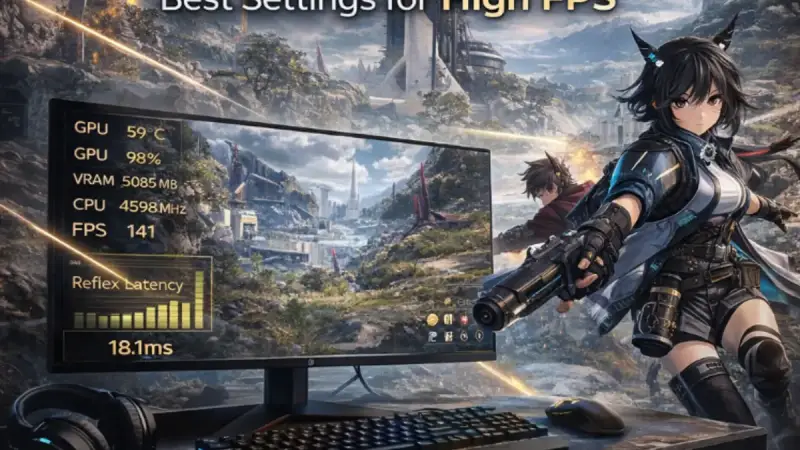
Your PC can run Arknights: Endfield — it just can’t run it smoothly yet. If you’re on a mid-range or aging rig and you keep watching that FPS counter drop into the 40s during combat, the issue is almost always a handful of specific settings doing disproportionate damage. This guide gives you an exact 60 FPS preset for 1080p, explains why each setting was changed, and includes a secondary 120 FPS competitive preset for hardware that can push further. For the full context behind every setting, see our complete Arknights: Endfield performance guide. If you work through this and stable 60 FPS still isn’t happening, your hardware may be the real ceiling — we’ll address that too.
Quick wins if you are in a hurry
- Drop Shadow Quality to Medium immediately. This is the single highest-impact setting in Endfield. Going from Ultra to Medium can recover 15-25% of your GPU budget depending on your card, based on community testing across multiple hardware configs.
- Set Particle Quality to Medium. Combat is where most low-end systems fall apart in Endfield, and particles are the main reason why. Medium is a meaningful step down from High in terms of GPU cost with a much smaller visual difference than you’d expect.
- Enable DLSS Quality or FSR Quality. If you haven’t already, upscaling at 1080p output is one of the most effective free FPS gains available. DLSS Quality on an RTX card at 1080p is nearly indistinguishable from native to most eyes.
- Turn off Motion Blur and Depth of Field. Neither affects gameplay and both cost GPU cycles. Turn them off permanently.
Got 10 more minutes? Keep reading for the full breakdown.
Before you go further
This guide builds on the assumption that your system is clean: updated drivers, no unnecessary overlays running, game in Exclusive Fullscreen, and Windows Power Plan set to High Performance. If any of those aren’t done yet, start with the Arknights: Endfield PC performance guide before touching individual settings. Optimizing settings on top of a misconfigured system will give you inconsistent results and make it harder to know what’s actually working.

Grab Your 6★ Weapon Before It's Gone!
- Free-to-play strategy
- Optimized for Windows PC

Start With 10,000+ Oroberyls , Hit Play!
- Arknights: Endfield — Free on PC. 10,000
- Oroberyls up for grabs.

Your Squad's Waiting. Jump In Free!
- New Homecoming Expansion: 2 Maps, 2 Operators, 1 Free 6★ Weapon: $0.
- Action RPG - Base Building on PC-Play Free, Keep Your Progress on Mobile.
What are the best settings for 60 FPS at 1080p in Arknights: Endfield?
The core principle here is identifying which settings cost the most GPU resources relative to what they contribute visually. Endfield is a UE5 game and several settings scale GPU cost aggressively at higher tiers while the visual jump from Medium to High or High to Ultra is often smaller than the performance cost suggests.
Here is the full 60 FPS preset for 1080p on mid-range hardware (tested baseline: RTX 3060, RX 6600 XT, and equivalent tier):
The 60 FPS Preset — 1080p
| Setting | Recommended Value | FPS Impact | Reason |
|---|---|---|---|
| Resolution | 1920×1080 | — | Base target |
| Render Scale / Upscaling | DLSS Quality or FSR Quality | High | Renders internally lower, upscales to 1080p; large FPS gain |
| Shadow Quality | Medium | Very High | Biggest single GPU cost in the game; Medium is still acceptable visually |
| Texture Quality | High | Low-Medium | Mostly VRAM, not raw FPS; keep High if you have 6GB+ VRAM |
| Ambient Occlusion | Medium | High | Ultra AO is expensive; Medium retains the contact shadow feel |
| Anti-Aliasing | Off (let DLSS/FSR handle it) | Medium | Redundant and costly when upscaling is active |
| Post-Processing Quality | Medium | Medium | Controls bloom, chromatic aberration, and related effects |
| Motion Blur | Off | Low-Medium | No gameplay benefit; free FPS |
| Depth of Field | Off | Low | Free FPS, especially during cutscenes |
| Particle Quality | Medium | High (in combat) | The main culprit for combat FPS drops on low-end hardware |
| Volumetric Fog | Medium | Medium | Expensive relative to visual contribution in most areas |
| Reflections | Medium | Low-Medium | Ultra reflections are ray-traced on some hardware; Medium uses screen-space |
| Level of Detail | High | Low | Controls object pop-in; keep High to avoid visual jarring |
| VSync | Off | — | Adds latency; use FPS cap instead |
| FPS Cap | 63 | — | Cap 3 above target for headroom; prevents frame queue buildup |

With this preset on an RTX 3060 or RX 6600 XT class GPU, you should see stable 60 FPS through most of Endfield’s content, including combat, based on community testing. Dense outdoor areas and large multi-enemy fights with heavy ability effects are the hardest stress points. If you still see dips below 60 in those specific moments, Particle Quality is your next dial to turn down.
What to do if you’re still below 60 FPS on this preset
Work through these in order, testing after each change:
- Drop Shadow Quality from Medium to Low
- Drop Particle Quality from Medium to Low
- Drop Ambient Occlusion from Medium to Off
- Drop Volumetric Fog from Medium to Low
- Switch upscaling from DLSS/FSR Quality to Balanced mode
If you’ve gone through all five of those and Endfield is still not holding 60 FPS at 1080p, the bottleneck is hardware, not settings. At that point, no preset will close the gap. The most cost-effective fix is usually a GPU upgrade, and I’ve tested several options specifically for this game. Our best GPU guide for Arknights: Endfield shows real benchmark numbers across the $250-$600 range so you can see exactly which card crosses the 60 FPS threshold at 1080p for your budget.
What are the best settings for low-end PCs in Arknights: Endfield?
Low-end in this context means hardware below the RTX 3060 or RX 6600 tier — cards like a GTX 1060, RX 580, GTX 1650, or integrated graphics on a modern laptop APU.
The honest reality is that Endfield on UE5 has a meaningful GPU floor. On a GTX 1060 6GB, even the most aggressive settings reductions will land you somewhere in the 35-50 FPS range at 1080p in combat. On a GTX 1650 or RX 580, similar range. Stable locked 60 FPS at native 1080p on these cards is not reliably achievable based on available community data.
What you can do is get the most stable experience possible:
| Setting | Low-End Value | Notes |
|---|---|---|
| Resolution | 1280×720 or 1600×900 | Drop native resolution before destroying quality settings |
| Upscaling | FSR Quality (output at 1080p from 720p base) | This is the most effective lever on non-RTX hardware |
| Shadow Quality | Low | Non-negotiable on this hardware tier |
| Texture Quality | Medium | Low VRAM cards (4GB) may need to drop to Low |
| Ambient Occlusion | Off | Free performance recovery |
| Particle Quality | Low | Combat is where these cards die; Low is necessary |
| Volumetric Fog | Low | |
| Reflections | Low | |
| Post-Processing | Low | |
| Motion Blur | Off | |
| Depth of Field | Off | |
| Level of Detail | Medium | Don’t drop below Medium; pop-in becomes visually disruptive |
Running 720p base with FSR Quality upscaling to 1080p output is the most viable path on genuinely low-end hardware. The image won’t be as sharp as native 1080p but it will be significantly more playable than native 1080p at Low settings without upscaling.
If you’re on a laptop, also check whether the game is running on your dedicated GPU and not the integrated graphics. In NVIDIA Control Panel or AMD Radeon Software, confirm Endfield is assigned to the discrete GPU. Laptop power management sometimes defaults to integrated graphics for “efficiency,” which will produce unplayable results regardless of settings.
What are the best settings for 120 FPS in Arknights: Endfield?

Targeting 120 FPS requires hardware in the RTX 4070 or RX 7800 XT range at 1080p, or the use of DLSS Frame Generation on RTX 40/50 series cards with a lower base tier. Here’s the competitive preset:
The 120 FPS Competitive Preset — 1080p
| Setting | Recommended Value | Notes |
|---|---|---|
| Resolution | 1920×1080 | |
| Upscaling | DLSS Quality (RTX) or FSR Quality (AMD) | Still beneficial even at this tier |
| Shadow Quality | High | Medium if frame budget is tight |
| Texture Quality | High | |
| Ambient Occlusion | High | Medium if needed |
| Anti-Aliasing | Off (handled by DLSS/FSR) | |
| Post-Processing | Medium | |
| Motion Blur | Off | Always off for competitive play |
| Depth of Field | Off | |
| Particle Quality | High | Only drop if combat dips below 100 FPS |
| Volumetric Fog | High | Drop to Medium if needed |
| Reflections | High | |
| Level of Detail | Ultra | Pop-in becomes more visible at higher framerates |
| VSync | Off | |
| NVIDIA Reflex | Enabled + Boost | Critical at this target; latency compounds at high framerates |
| FPS Cap | 123 | Cap 3 above target |
At 120 FPS the input latency benefits of Reflex and a proper FPS cap become more meaningful. The difference between 60 FPS and 120 FPS in Endfield’s combat is substantial for reaction-based play — dodge timing in particular feels much more forgiving. If you have a 144Hz monitor and an RTX 40 series card, enabling DLSS Frame Generation on top of this preset to push toward 144 FPS is a reasonable next step. Just keep Reflex on when Frame Generation is active.
Common issues and fixes
Issue: FPS is stable in exploration but drops hard during multi-ability combat. Fix: Particle Quality is almost always the cause. Drop it from Medium to Low. If you already did that, check whether Volumetric Fog is set above Medium — it compounds with particle effects in busy scenes.
Issue: Settings are all on Low but the game still stutters in the first 15 minutes. Fix: That’s shader compilation, not settings. Let the game run through a few combat encounters without changing anything. Shader stutter on first run is normal in UE5 games and largely disappears after the initial session.
Issue: Enabling FSR made the image blurry even though FPS improved. Fix: FSR Performance mode is too aggressive for 1080p output. Switch to FSR Quality. Also add a small positive sharpness value in the game’s image settings if available.
Issue: FPS cap is set to 60 but the game still drops below it. Fix: A hard cap at exactly your target means any dip causes a miss. Cap at 63 instead of 60. This gives the frame budget headroom for spikes without adding meaningful latency.
Quick checklist before you launch
- Shadow Quality at Medium (or Low on genuinely budget hardware)
- Particle Quality at Medium (Low if still struggling in combat)
- DLSS Quality or FSR Quality enabled
- Anti-Aliasing set to Off when upscaling is active
- Motion Blur and Depth of Field both off
- Ambient Occlusion at Medium
- VSync off, FPS cap at 63 for 60 FPS target
- Exclusive Fullscreen confirmed
- Windows Power Plan set to High Performance
- All overlays disabled
If you’ve applied this preset and stable 60 FPS still isn’t there, the next step is figuring out whether RAM or storage is contributing to the drops. Paging issues during combat look exactly like GPU drops on the surface but have a different fix entirely. Our lag and input latency guide covers that overlap and will help you tell the difference.